#PurpleThursday: A Conversation about Domestic Violence and Healthy Relationships with BFC Attorney Astrid
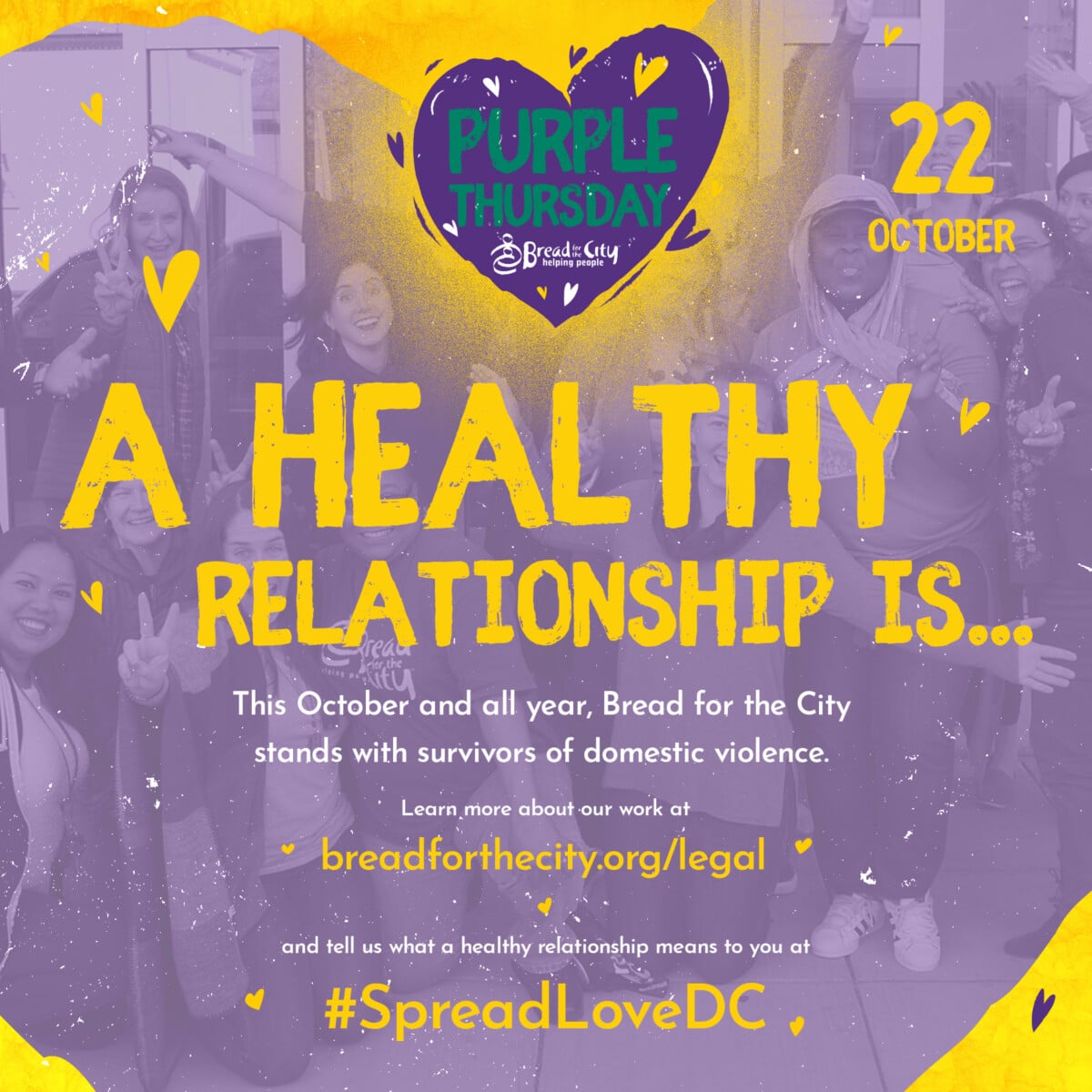
Today Bread for the City celebrates Purple Thursday, a day dedicated to showing support for survivors and ending domestic violence. Domestic violence has always been an issue, but since the COVID-19 pandemic, there has been a tremendous spike in incidents of abuse. Even though we’re all facing unprecedented times, we must continue the fight to end domestic abuse. We got the chance to speak with Bread for the City Family Attorney, Astrid, about how the organization shows its support for survivors.
Why is it important for Bread for the City to celebrate Purple Thursday?
Astrid: I think it’s important because it’s an opportunity for us to raise awareness about domestic violence as well as showing our commitment to promoting healthy relationships. I think a lot of the conversations around Domestic Violence Awareness Month tends to explain domestic violence, but we also should be talking about healthy relationships. It’s really important to highlight and uplift those healthy relationships during this time.
How does BFC help domestic violence survivors?
Astrid: In general, the organization supports the community and the community includes survivors of domestic violence. In the legal clinic, we have the family law team which works on domestic violence cases assisting survivors to pursue civil protection orders. Right now during the pandemic, this has brought unique challenges as the courts are operating virtually. We also help survivors with related issues of domestic violence such as custody..
Why is our work so important?
Astrid: I think in general it’s important because we should all be free of violence especially in our homes. Your home is supposed to be the safest place, but when you’re in these situations where your home is invaded by this type of violence then there’s no safe place anymore. We need to support survivors to achieve some sense of security whether it is through legal action or providing other services and resources. Domestic violence is something that everyone is touched by in some way – whether it’s from personal experience or the experience of a mother, a sibling, a relative, or a friend. It could happen in heterosexual relationships, queer relationships, rich people, or people who don’t have any money. Our work specifically bridges the gaps and provide access to justice in a trauma-informed way.
Do you believe the pandemic is having an impact on domestic violence?
Astrid: Unfortunately, the pandemic has created a situation where there is no escape. An escape or avenue to leave a toxic situation are not as accessible. There is no going to work to get away from what’s going on at home or other places where they hope to find refuge. Now those places aren’t as accessible. There’s also a higher risk of violent behavior because the stress of the pandemic creates more tension or outburst because you’re at home cooped out which is not good for even healthy relationships.
As an attorney, how does it make you feel to help those who are survivors of domestic violence?
Astrid: As a childhood survivor of domestic violence, I am humbled and grateful to have the opportunity and ability to serve survivors of domestic violence. I can’t guarantee that violence will stop. However, there’s something to be said about having an order in place that will hold that person accountable. An order from the court, unfortunately, doesn’t prevent someone from harming another. If someone is committed to being a perpetrator or being violent, a piece of paper may not stop them. But the relief that I can advocate for as a survivor’s attorney can make a difference in ensuring safety for the survivor and their family. As an attorney, it is my goal to be understanding, compassionate, and fierce in my representation so that my client can get what they need to reclaim their power and end domestic violence in their life.
Related Posts
A 30-Year Legacy in Action: Celebrating George A. Jones

Public Dollars for Public Good